Pile Driving Barge vs. Backhoe Dredger: Which Is Right for Your Port Foundation Project?
Pile Driving Barge vs. Backhoe Dredger: Which Is Right for Your Port Foundation Project?
Choosing between a pile driving barge and a backhoe dredger is one of the first vessel decisions a port or bridge foundation project forces on a procurement team. It is also one of the most frequently mis-framed, because the two vessels are usually listed side by side as if they were substitutes. They are not. They perform different tasks on the same waterfront.
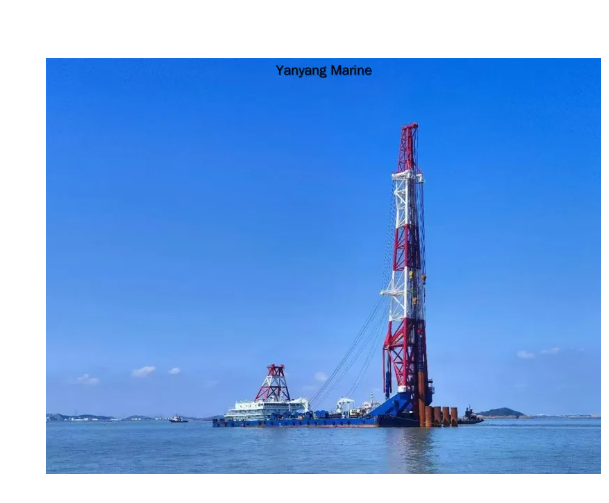
A pile driving barge installs foundation piles. Yanyang Marine’s 110m pile leader height Pile Driving Barge is a steel pile-driving vessel built for port and bridge construction, with an overall length of approximately 118.50 m, a breadth of 37.70 m and a depth of 7.70 m, and a working envelope that covers planting piles of Ø4000 mm at a typical weight of 400 t.
A backhoe dredger excavates and removes material. The EX5500 Self Propelled Backhoe Dredger is fitted with a Hitachi EX 5500 excavator delivering 2 × 1076 kW of excavator power, offers dredging depth options of 18 m, 24 m or 32 m, and works with bucket capacities of 15 m³, 18 m³ or 20.5 m³, supported by 2 × 350 kW of propulsion power.
If the scope is pile installation, no dredger replaces a piling barge. If the scope is excavation down to formation level, no piling barge replaces a dredger. Most port foundation projects need both, which turns the real question into one of task split, specification envelope and sequencing. This guide compares the two vessel types on task suitability, operational capability and the project-specific demands that decide which asset — or which combination — a buyer should commit to.
Problem Definition: Two Different Jobs on the Same Waterfront
The confusion starts with language. In tenders, equipment lists and early budget estimates, both vessels are often described as “marine construction units” or “port equipment”, which makes them look interchangeable on a comparison sheet. Operationally they are not interchangeable at all.
A pile driving barge is a floating platform that positions, handles and drives piles. Its decisive specifications are leader and frame height, pile diameter, pile length and pile weight — the envelope that determines whether a given foundation design can be installed from the deck at all. A backhoe dredger is a floating excavator. Its decisive specifications are dredging depth, bucket capacity and excavator power — the envelope that determines how deep material can be removed and how productively.
Three mis-framings appear repeatedly in early-stage procurement:
- Treating the two vessels as substitutes. A buyer who compares them on unit price before fixing the scope is comparing two assets that cannot perform each other’s work.
- Committing before the scope is frozen. If the pile envelope or the design dredging depth changes after the vessel is selected, the vessel may no longer fit the project.
- Ignoring the support fleet. Excavated material still has to be transported. The Yanyang Marine 2600m³ Split Hopper Barge (CCS), part of the 1200–3200m³ Split Hopper Barge category, is designed for transporting material in coastal and inland waterway projects — a reminder that a port foundation programme is usually a vessel set, not a single unit.
The practical working definition is therefore: choose the pile driving barge when the deliverable is installed piles, and choose the backhoe dredger when the deliverable is excavated volume to a defined depth. Everything below expands those two envelopes.
Industry Background: Why Both Vessel Types Are in Demand
Port foundation work does not happen in isolation from the wider dredging and marine construction market. Grand View Research valued the global dredging equipment market at USD 4.86 billion in 2023 and projects it to reach USD 7.36 billion by 2030. Published estimates for the same period differ substantially depending on scope — equipment-only sales versus full dredging service revenue — so buyers should read market-size figures as directional rather than interchangeable.
Vessel-type mix matters as much as total market size. Grand View Research reports that hydraulic dredgers, including cutter suction dredgers, held the largest revenue share at approximately 46.65% in 2023. Future Market Insights estimates that trailing suction hopper dredgers will account for around 46.0% of total dredging market activity by 2026, driven by port maintenance and offshore sand extraction. Neither figure isolates backhoe dredgers or pile driving barges as separate categories, which reflects how these vessels are actually bought: for defined construction tasks rather than for bulk maintenance dredging alone.
Two demand drivers sit directly behind port foundation projects:
- Port expansion and deep-water access. Berth boxes, approach channels and quay walls require excavation to formation level before foundations can be installed — work that combines dredging and piling in one sequence.
- Offshore wind. The Global Wind Energy Council (GWEC) identifies offshore wind as a key emerging driver for dredging equipment, with specialized vessels required for seabed preparation and cable trenching for over 380 GW of new capacity by 2033.
Standards and classification add a third layer. ISO 8384:2019 provides the international standard vocabulary and definitions for dredgers, while classification societies such as Bureau Veritas (BV) and DNV publish dredger-specific rules, including guidelines for the assignment of reduced freeboards. For buyers, this means vessel type, class notation and statutory vocabulary are all part of the specification package, not paperwork bolted on at the end.
Zhenjiang Yanyang Engineering Co., Ltd., trading as Yanyang Marine, is a dredger and offshore vessel designer, builder and exporter established in 1996 in Zhenjiang, Jiangsu Province, China. The company specialises in designing, manufacturing and selling dredgers, barges and offshore vessels for port and offshore projects; approximately 100% of its products are exported, with major markets including the United Arab Emirates, Indonesia, India, Egypt, Turkey, Nigeria, South Africa, Tanzania, Saudi Arabia and Oman. The two vessels compared in this article come from that product line.
Detailed Solution: The Two Vessels, Specified
Pile Driving Barge: The Pile Installation Envelope
The 110m pile leader height Pile Driving Barge is a steel pile-driving vessel classified for port and bridge construction. Its published configuration is the reference point for any project whose foundation design calls for large-diameter, heavy piles:
- Length overall: approximately 118.50 m
- Breadth: 37.70 m
- Depth: 7.70 m
- Pile frame height (above design draft): 137.00 m
- Typical diameter of planting pile: Ø4000 mm
- Typical length of planting pile: 107 m + depth of water
- Typical weight of planting pile: 400 t
- Material: steel
- Application: port and bridge construction
Those numbers should be read as an envelope, not a brochure. The pile frame height of 137.00 m above design draft is what allows the vessel to handle a typical planting pile of 107 m plus the water depth in which it is driven — the vertical reach is dimensioned around long piles placed in deep water rather than around short quay piles. The typical pile diameter of Ø4000 mm and typical pile weight of 400 t define the load that the handling and driving system must control. The hull — approximately 118.50 m long and 37.70 m wide, with a depth of 7.70 m — provides the working platform and stability that a 400 t pile cycle requires.
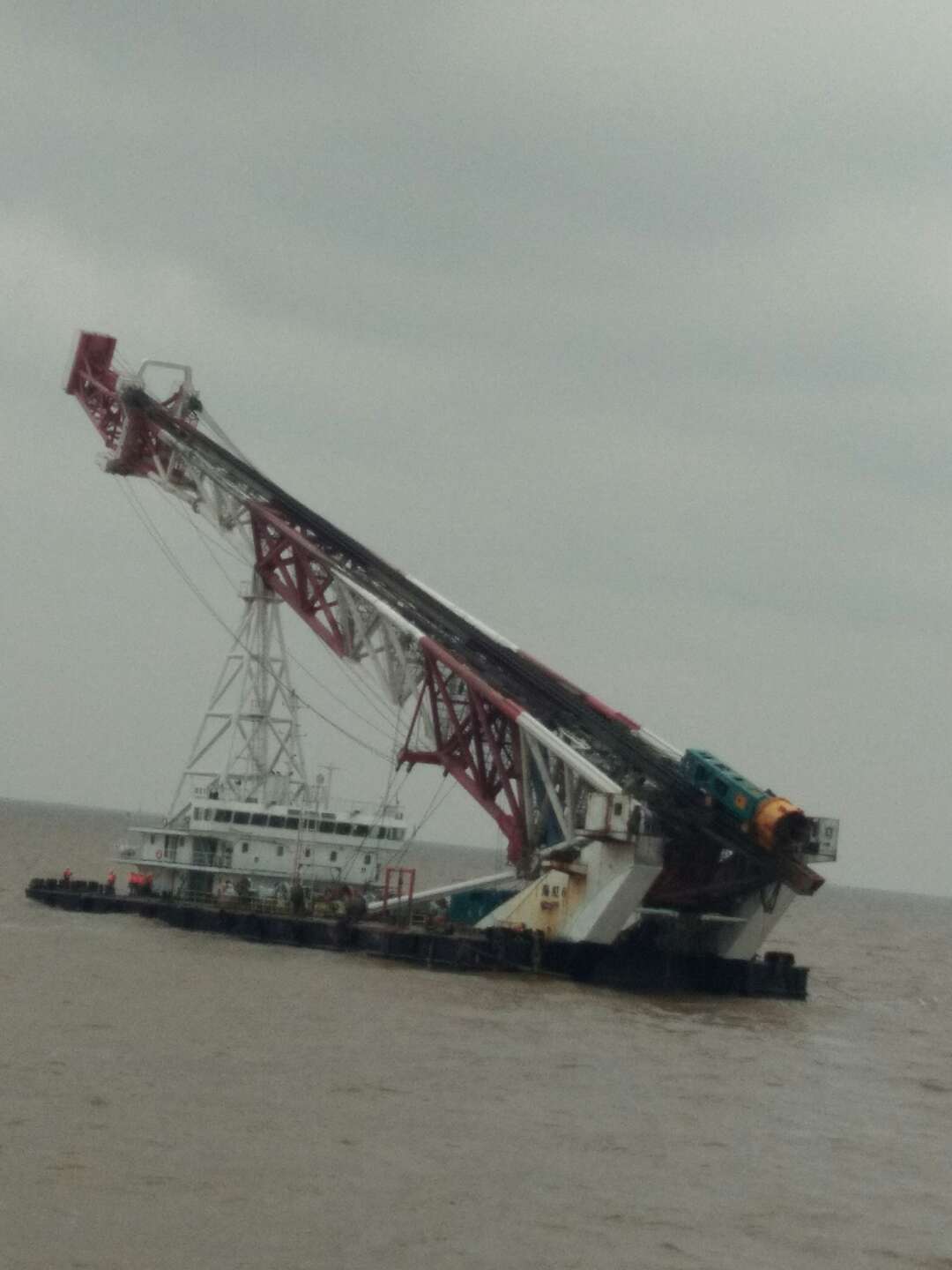
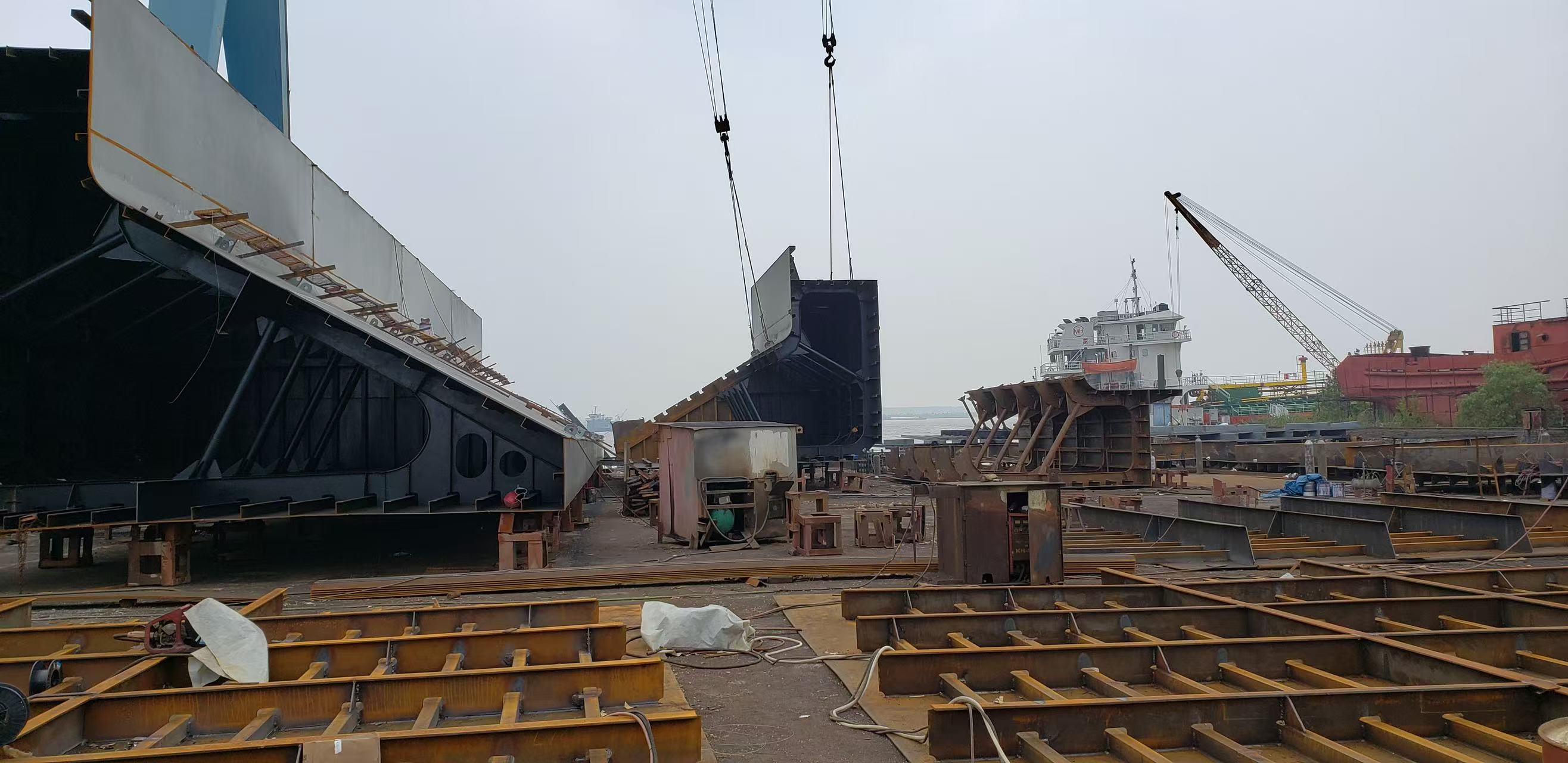
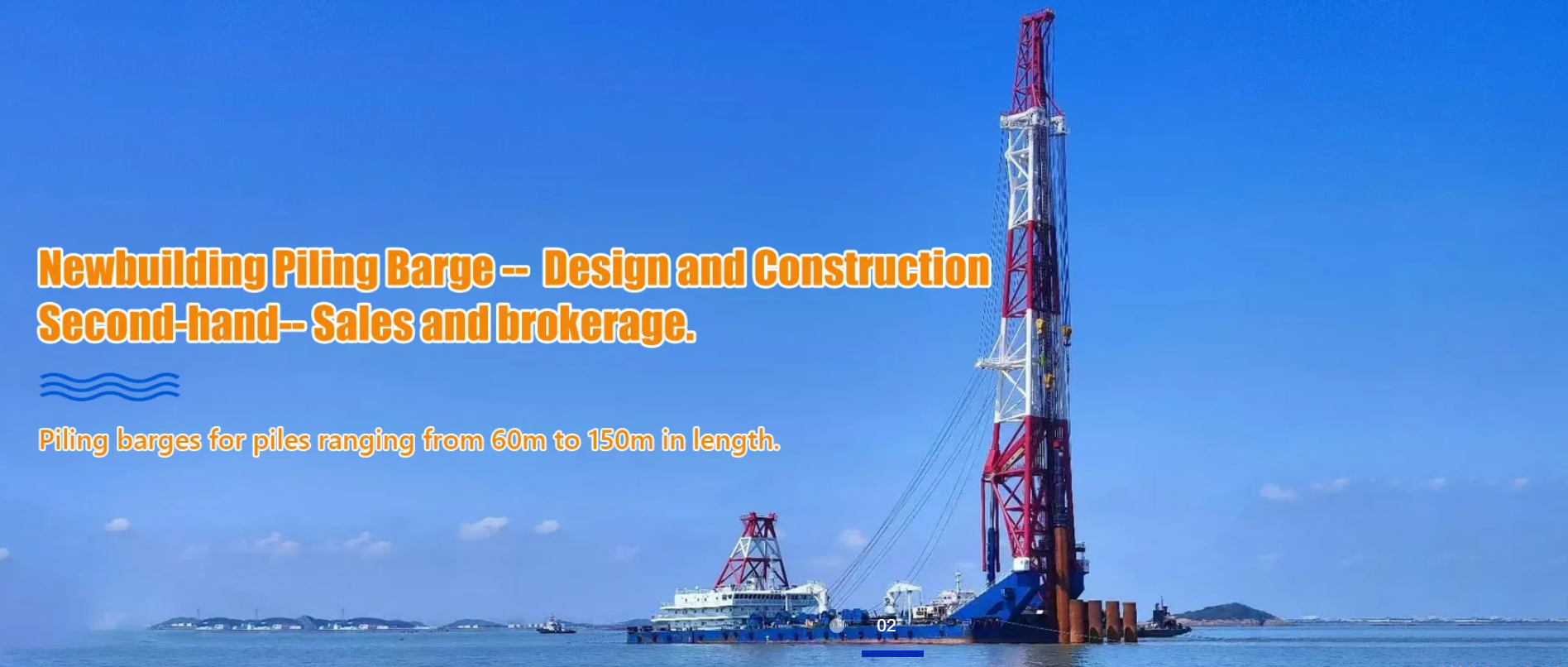
What a pile driving barge cannot do is remove material. Where the seabed sits above formation level, preparatory excavation is a separate scope, and that is where the second vessel type enters the comparison. Yanyang Marine builds this vessel class in more than one leader configuration; the vessel reference shown below is a 105 m pile leader height pile driving barge from the same class.
Backhoe Dredger: The Excavation Envelope
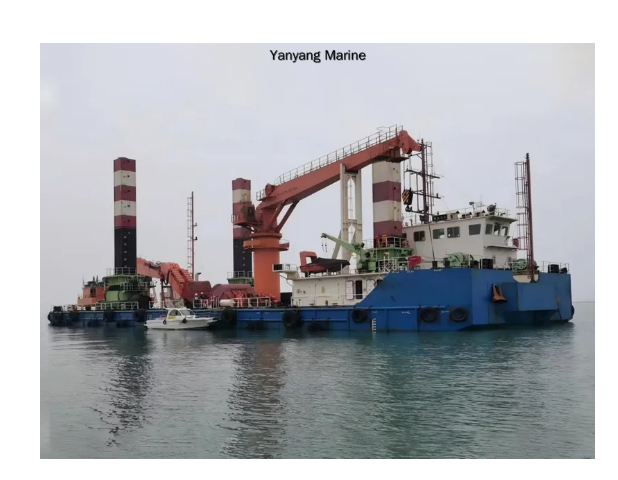
The EX5500 is a self-propelled backhoe dredger, classified as an EX5500 Self Propelled Backhoe Dredger and constructed in steel. Its configuration is defined by three variables — reach, bucket and power:
- Overall length: 71.5 m
- Beam: 22 m
- Draft: 2.5 m
- Excavator model: Hitachi EX 5500
- Excavator power: 2 × 1076 kW
- Dredging depth options: 18 m / 24 m / 32 m
- Bucket capacity options: 15 m³ / 18 m³ / 20.5 m³
- Propulsion power: 2 × 350 kW
- Intended duty: self-propelled operation sufficient for long-term offshore dredging operations globally
- Material: steel
The depth and bucket options are a configuration decision, not a fixed rating. A project that requires excavation to 18 m and one that requires 32 m are specifying different versions of the same vessel, and the bucket choice of 15 m³, 18 m³ or 20.5 m³ trades individual bite size against material behaviour and the precision the design requires. The excavator power of 2 × 1076 kW, delivered by a Hitachi EX 5500 unit, sets the digging capability behind the bucket, while 2 × 350 kW of propulsion means the vessel repositions under its own power rather than waiting on tug support — a real cost factor on offshore sites where support-vessel time is charged by the day.
The 71.5 m length, 22 m beam and 2.5 m draft describe a comparatively compact, shallow-draft platform. For buyers this is often the deciding geometry: a backhoe dredger can work where a larger dredger cannot reach, and it excavates with a precision that bulk dredging methods generally do not match. What it does not do is install piles.
Step-by-Step Breakdown: Six Checks Before You Commit
The following sequence applies whether you are specifying one vessel or planning a full port foundation fleet. Steps 1 to 3 decide which vessel; steps 4 to 6 decide which configuration and which schedule.
Step 1 — Fix the deliverable. Establish whether the contract is measured in installed piles, in excavated volume, or in both. Installed piles point to the pile driving barge; excavated volume points to the backhoe dredger; both means the two vessels are sequenced rather than compared. This single question eliminates most of the confusion in early-stage vessel selection.
Step 2 — Define the pile envelope. Record pile diameter, pile length, pile weight and water depth, then test them against the pile driving barge envelope: a pile frame height of 137.00 m above design draft, a typical planting pile diameter of Ø4000 mm, a typical pile length of 107 m + depth of water, and a typical pile weight of 400 t. If the design falls outside the envelope, the vessel is not a candidate regardless of price.
Step 3 — Define the excavation envelope. Record the design dredging depth and the bucket characteristics the material and tolerance require, then test them against the backhoe dredger options: dredging depths of 18 m, 24 m or 32 m, bucket capacities of 15 m³, 18 m³ or 20.5 m³, and 2 × 1076 kW of excavator power behind the bucket. Selecting a deeper configuration or a larger bucket is a specification change, not an upgrade option.
Step 4 — Check geometry and site access. The piling barge’s 37.70 m breadth and 7.70 m depth, and the backhoe dredger’s 22 m beam and 2.5 m draft, describe very different site footprints. Berth access, water depth along the mobilisation route, working area and barge or tug interfaces all need to be checked against the vessel that will actually be mobilised — not against the vessel on the brochure cover.
Step 5 — Confirm class, standards and the compliance path. Yanyang Marine vessels can be classed by IACS societies including CCS, BV, LR and DNV. Dredging and marine engineering requirements for offshore and coastal operations commonly call for CCS/BV/DNV class certification, corrosion-resistant steel and dynamic positioning. ISO 8384:2019 supplies the standard dredger vocabulary, and BV and DNV publish dredger-specific rules, including guidance on reduced freeboards. Fix the class notation early, because it constrains the design rather than confirming it afterwards.
Step 6 — Plan the build route and lead time. Lead time depends on configuration. Yanyang Marine quotes 2–3 months for standard vessels and 8–12 months for custom dredgers, with customisation covering dredging depth, discharge distance, power and configuration. Any change to the envelope defined in step 2 or step 3 therefore carries a schedule consequence, which is why the envelope should be frozen before design is released.
Use Cases: Which Vessel for Which Project Scenario
Scenario 1 — Bridge pier and port foundation piling. The deliverable is installed piles. The pile driving barge is the operative asset, and its envelope — 137.00 m pile frame height above design draft, Ø4000 mm pile diameter, 107 m + water depth pile length, 400 t pile weight — is what the foundation design must fit. A backhoe dredger contributes only if the seabed must first be lowered to the piling level.
Scenario 2 — Berth box and approach excavation. The deliverable is excavated volume to a design depth. The self-propelled backhoe dredger is the operative asset, configured to 18 m, 24 m or 32 m of dredging depth with a 15 m³, 18 m³ or 20.5 m³ bucket. Because it repositions under its own 2 × 350 kW propulsion, it suits sites where support-vessel availability is a constraint.
Scenario 3 — A combined foundation programme. This is the most common port foundation sequence: excavate to formation level with the backhoe dredger, install the piles with the pile driving barge, and remove surplus material with a split hopper barge such as the 2600m³ Split Hopper Barge (CCS), designed for transporting material in coastal and inland waterway projects. Planned as a set, the three tasks share mobilisation windows and survey control; planned separately, they tend to generate idle days between scopes.
Scenario 4 — Offshore and coastal exposure. The backhoe dredger’s configuration is described as sufficient for long-term offshore dredging operations globally, which makes it the more naturally offshore-capable of the two. The pile driving barge remains the pile installation asset, but its suitability depends on the water depth and access conditions of the specific site. Offshore wind adds a further dimension here: GWEC links the growth of offshore wind to demand for specialized vessels for seabed preparation and cable trenching, in a market requiring over 380 GW of new capacity by 2033.
When neither vessel is the whole answer. If the programme also includes large-scale channel excavation or reclamation, other vessel types carry those scopes — the Yanyang Marine line includes a 1000–8000m³/h CSD (8000m³/h self-propelled class) and a 26800m³ TSHD. The comparison in this article is deliberately narrow: for the two tasks named in the title, the envelope checks above decide the choice.
Side-by-Side Comparison: Pile Driving Barge vs. Backhoe Dredger
The table below compares the two vessels using published configuration data. Rows marked “not applicable” reflect a task the vessel is not designed for; rows marked “not stated in the source specification” reflect a parameter that is not part of the published configuration and should therefore be confirmed during quotation.
| Specification | Pile Driving Barge (110m pile leader height model) | Backhoe Dredger (EX5500) |
|---|---|---|
| Vessel type | Pile-driving vessel | EX5500 self-propelled backhoe dredger |
| Primary task | Installing foundation piles for port and bridge construction | Excavating seabed material; configured for long-term offshore dredging operations globally |
| Length overall | Approximately 118.50 m | 71.5 m |
| Breadth / beam | 37.70 m | 22 m |
| Depth / draft | 7.70 m (depth) | 2.5 m (draft) |
| Pile frame / leader height | 137.00 m above design draft (model designated by 110 m pile leader height) | Not applicable |
| Typical planting pile diameter | Ø4000 mm | Not applicable |
| Typical planting pile length | 107 m + depth of water | Not applicable |
| Typical planting pile weight | 400 t | Not applicable |
| Excavator / driving plant | Not stated in the source specification | Hitachi EX 5500; 2 × 1076 kW |
| Dredging depth | Not applicable | 18 m / 24 m / 32 m |
| Bucket capacity | Not applicable | 15 m³ / 18 m³ / 20.5 m³ |
| Propulsion | Not stated in the source specification | 2 × 350 kW, self-propelled |
| Material | Steel | Steel |
| Classification | Yanyang Marine vessels can be classed by IACS societies including CCS, BV, LR and DNV | |
How to read this table: the pile driving barge rows describe a pile installation envelope; the backhoe dredger rows describe an excavation envelope. A project that contains both scopes will appear in both columns — that is not a contradiction, it is a two-vessel work plan.
FAQ: Pile Driving Barge vs. Backhoe Dredger
Do pile driving barges and backhoe dredgers need classification society approval?
It depends on the project’s regulatory, insurance and client requirements, but the vessels are built to be classed. Yanyang Marine vessels can be classed by IACS societies including CCS, BV, LR and DNV. Dredging and marine engineering requirements for offshore and coastal operations commonly call for CCS/BV/DNV class certification, corrosion-resistant steel and dynamic positioning. ISO 8384:2019 provides the international standard vocabulary and definitions for dredgers, while Bureau Veritas (BV) and DNV publish dredger-specific rules, including guidelines for the assignment of reduced freeboards. The 2600m³ Split Hopper Barge (CCS) in the same Yanyang Marine fleet is an example of a vessel built to CCS class.
Can a backhoe dredger install piles, or can a pile driving barge dredge?
No to both. The EX5500 Self Propelled Backhoe Dredger is an excavation asset: dredging depth options of 18 m, 24 m or 32 m and bucket capacities of 15 m³, 18 m³ or 20.5 m³, powered by a Hitachi EX 5500 excavator at 2 × 1076 kW. Its published capability envelope does not include pile installation. The 110m pile leader height Pile Driving Barge is a pile-driving vessel for port and bridge construction with a pile frame height of 137.00 m above design draft and a typical planting pile envelope of Ø4000 mm, 107 m + water depth and 400 t; it does not excavate. A project that requires both tasks uses both vessels in sequence.
What drives the cost of each vessel type?
For the pile driving barge, the main cost drivers are leader and frame height (the featured model is designated by a 110 m pile leader height, with a pile frame height of 137.00 m above design draft), the pile envelope the vessel must handle (Ø4000 mm diameter, 400 t weight) and the hull dimensions of approximately 118.50 m × 37.70 m × 7.70 m. For the backhoe dredger, cost is driven by the excavator class and power (Hitachi EX 5500, 2 × 1076 kW), the selected dredging depth option (18 m, 24 m or 32 m), the bucket capacity (15 m³, 18 m³ or 20.5 m³) and self-propulsion (2 × 350 kW). Yanyang Marine states that its products offer approximately 50% lower cost than European manufacturers while maintaining high quality; because the two vessel types are specified so differently, buyers should treat configuration-level pricing as a quotation exercise rather than a list-price comparison.
How can a buyer validate a vessel configuration before construction starts?
For vessels of this size, validation is a configuration and engineering review rather than a physical sample. Yanyang Marine’s process covers custom design and engineering, factory construction and testing, shipping and global delivery, on-site commissioning and operator training, long-term spare parts supply and worldwide after-sales technical support. Because dredging depth, discharge distance, power and configuration are customisable, the pile envelope or excavation envelope should be frozen and reviewed against the design before construction is released.
What lead times should be planned for each vessel?
Yanyang Marine quotes 2–3 months for standard vessels and 8–12 months for custom dredgers. Because the backhoe dredger is offered in three dredging depth options and three bucket capacities, and the pile driving barge is configured around a specific leader height and pile envelope, the configuration selected determines which schedule applies. Buyers planning a port foundation programme normally work backwards from the piling start date to fix the dredging window. To discuss a specific pile envelope or dredging depth for your project, contact Yanyang Marine at Info@yanyangmarine.com or via WhatsApp at +86 159-5290-0547.
Conclusion: Decide by Task, Then by Envelope
A pile driving barge and a backhoe dredger are not alternatives on the same line of a comparison sheet — they are consecutive assets in a port foundation programme. Choose the pile driving barge when the deliverable is an installed pile envelope of up to Ø4000 mm diameter, 107 m + water depth length and 400 t weight, supported by a pile frame height of 137.00 m above design draft. Choose the backhoe dredger when the deliverable is excavation to 18 m, 24 m or 32 m with a 15 m³, 18 m³ or 20.5 m³ bucket and 2 × 1076 kW of excavator power behind it. When the project contains both tasks, sequence them and plan the support fleet — including material transport — as one vessel set from the start.
Zhenjiang Yanyang Engineering Co., Ltd. (Yanyang Marine), established in 1996 and based in Zhenjiang, Jiangsu Province, China, designs, builds and exports dredgers, barges and offshore vessels for port and offshore projects. Its product line includes Cutter Suction Dredgers, Trailing Suction Hopper Dredgers, Split Hopper Barges, Grab Dredgers, Backhoe Dredgers and Pile Driving Barges, with approximately 100% of products exported to markets including the United Arab Emirates, Indonesia, India, Egypt, Turkey, Nigeria, South Africa, Tanzania, Saudi Arabia and Oman.
Next Step: Check Your Envelope Against the Specification
Send the pile diameter, pile length, pile weight and design dredging depth for your project, and Yanyang Marine can confirm which vessel configuration applies and what lead time it carries.
Email: Info@yanyangmarine.com · WhatsApp: +86 159-5290-0547 · Website: www.yanyangmarine.com
Have Questions or Need More Details?
Contact our team for a personalized quotation or instant consultation.
Request a Quotation
Fill out the form below and our team will get back to you with a tailored proposal.
WhatsApp Direct Chat
Prefer to chat in real-time? Message us on WhatsApp for instant assistance & quick answers.
- Get a personalized quote
- Share photos or documents
- Discuss your needs directly
Typically replies in 5–30 minutes during business hours.