Deep-Water Dredging to 115 m: Inside the 26,800 m³ TSHD
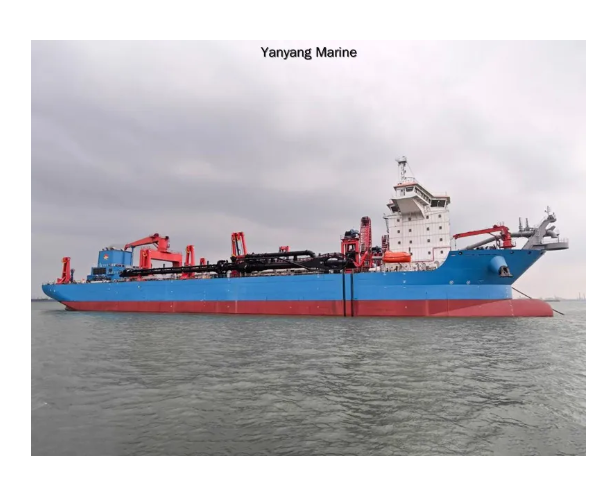
Deep-water channel and port expansion programmes rarely fail on one specification. They fail where depth reach, hopper volume, station-keeping and class compliance stop supporting each other. Zhenjiang Yanyang Engineering Co., Ltd. (Yanyang Marine), a dredger manufacturer and exporter based in Zhenjiang, China, builds a 26,800 m³ trailing suction hopper dredger (TSHD) rated for 40 / 70 / 115 m dredging depth, with a Φ1200 mm suction pipe and 27,726 kW of installed power. This article maps each verified specification to the project problem it is designed to solve.
The Core Problem: One Vessel Has to Reach 115 m and Move 26,800 m³
Two variables decide whether a dredger can serve a deep-water project: the maximum depth the suction system can work at, and the volume of material the vessel can carry in one cycle. On a conventional design these two variables pull against each other. A longer suction pipe adds weight and hydraulic head that the dredge pumps must overcome. A larger hopper adds hull size, draft and manoeuvring demand, which changes what the vessel can access at both ends of the cycle — the dredging site and the disposal or reclamation area.
If a project needs 115 m of reach, it cannot be solved by adjusting one parameter in isolation. Four requirements have to hold at the same time:
- Reach. Depth capability is set by the suction pipe diameter and the pump arrangement behind it. The 26,800 m³ TSHD is rated for 40 / 70 / 115 m with a Φ1200 mm suction pipe, supported by 2 × 6,000 kW inboard dredge pumps, 2 × 3,300 kW underwater pumps and 2 × 2,000 kW jet water pumps.
- Cycle economics. Hopper volume determines how much material each trip moves. At approximately 26,800 m³, the vessel is configured for high volume per cycle rather than frequent, small loads — relevant when sailing distance to the reclamation or disposal area is substantial.
- Station-keeping. Working over a suction point in open sea requires controlled positioning. The vessel carries DP-1 notation, with main thrusters rated 2 × 10,500 kW, bow thrusters 2 × 1,100 kW and a stern thruster of 1 × 1,100 kW.
- A support train. A deep-water dredger does not operate alone. Documented operating requirements state that it must be used with dredge pumps, pipelines, surveying systems and anchor handling equipment, and that it operates in continuous mode, either self-propelled or barge-towed.
For project managers, the practical implication is that depth and volume should be specified together, at tender stage, not negotiated one after the other during execution.
Industry Background: Why Deep-Water Capacity Demand Is Rising
The global dredging equipment market was valued at USD 4.86 billion in 2023 and is projected to reach USD 7.36 billion by 2030, according to Grand View Research. The same analysis places hydraulic dredgers, including cutter suction dredgers, at the largest revenue share of approximately 46.65% in 2023.
Trailing suction hopper dredgers are a distinct and growing part of that activity. A Future Market Insights dredging market report estimates that TSHDs will account for around 46.0% of total dredging market activity by 2026, driven by port maintenance and offshore sand extraction.
Two demand-side drivers matter for deep-water capability specifically. First, energy, metallurgy and mineral projects depend on channel depth: bulk terminals, ore berths and large tanker berths only function at their intended throughput if the approach channel holds design depth, and deeper design drafts narrow the pool of vessels able to maintain them. Second, offshore wind development is adding a separate workload. The Global Wind Energy Council (GWEC) identifies seabed preparation and cable trenching for more than 380 GW of new offshore wind capacity by 2033 as a significant emerging driver for dredging equipment.
The supply side is concentrated. Fortune Business Insights identifies Royal IHC, Damen Shipyards Group, Jan De Nul Group and Boskalis as the top-tier global manufacturers and contractors in the sector. Chinese builders, including Yanyang Marine, serve buyers who need class-compliant deep-water capacity under different cost and delivery parameters. On the standards side, ISO 8384:2019 provides the international vocabulary for dredger types, while classification societies publish dredger-specific rules — Bureau Veritas, for example, issues guidelines for the assignment of reduced freeboards for dredgers. These documents shape how a deep-water TSHD is specified in tender packages.
The 26,800 m³ TSHD: Specification-to-Problem Mapping
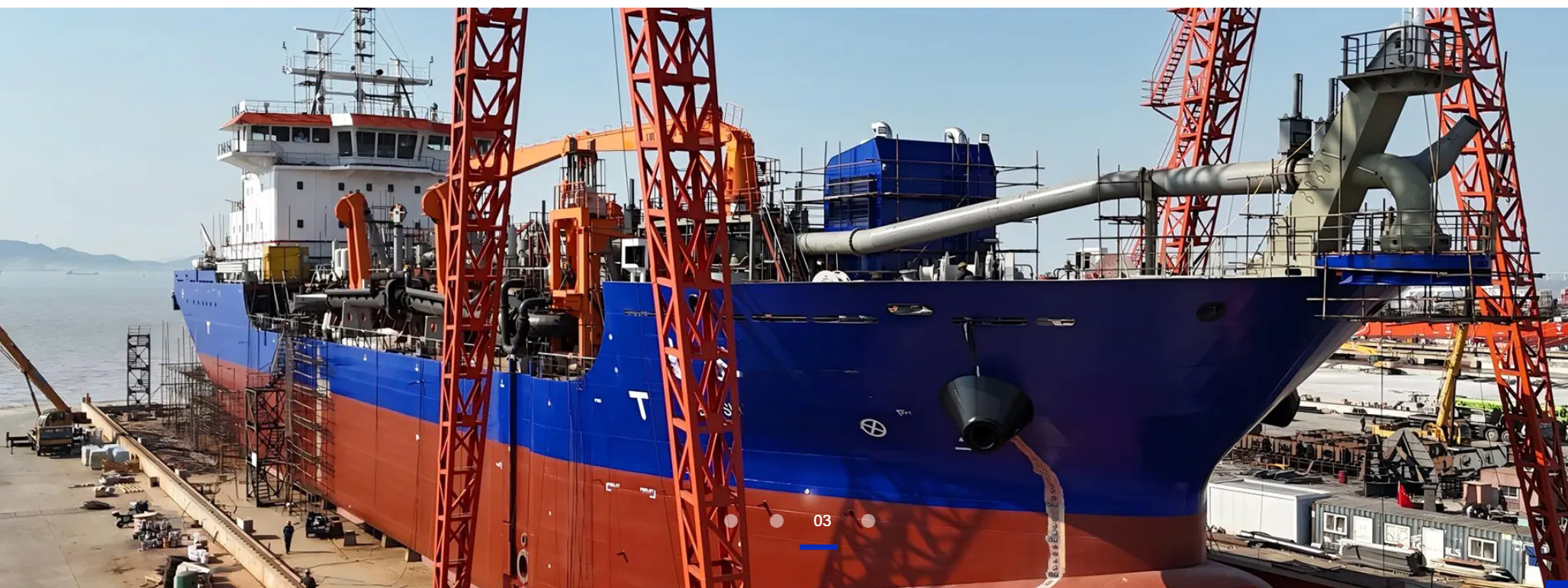
The vessel is a self-propelled, CCS-classed trailing suction hopper dredger. Each figure below is a verified configuration value for this model, paired with the project constraint it addresses.
1. Depth envelope — 40 / 70 / 115 m
Three rated dredging depths let one hull cover staged scopes within a single programme: channel sections and berth pockets at the shallower end, and the deepest reaches where the design depth exceeds what standard TSHDs can address. The applicable project profile documented for this vessel is deep-water channels, port expansion and large-scale reclamation, with stable performance in harsh open sea conditions.
2. Hopper capacity — approx. 26,800 m³
Hopper volume is the capacity variable that determines trips per volume of material moved. Supporting dimensions define where that volume can physically operate: length over all approximately 171.20 m, length between perpendiculars 160.00 m, moulded breadth 36.00 m, moulded depth 15.80 m, and draft at international freeboard 9.50 m. Service speed is approximately 15.5 knots at a draft of 11.5 m, which sets the cycle time between dredging ground and discharge point.
3. Suction and pump train — Φ1200 mm, 2 × 6,000 kW inboard
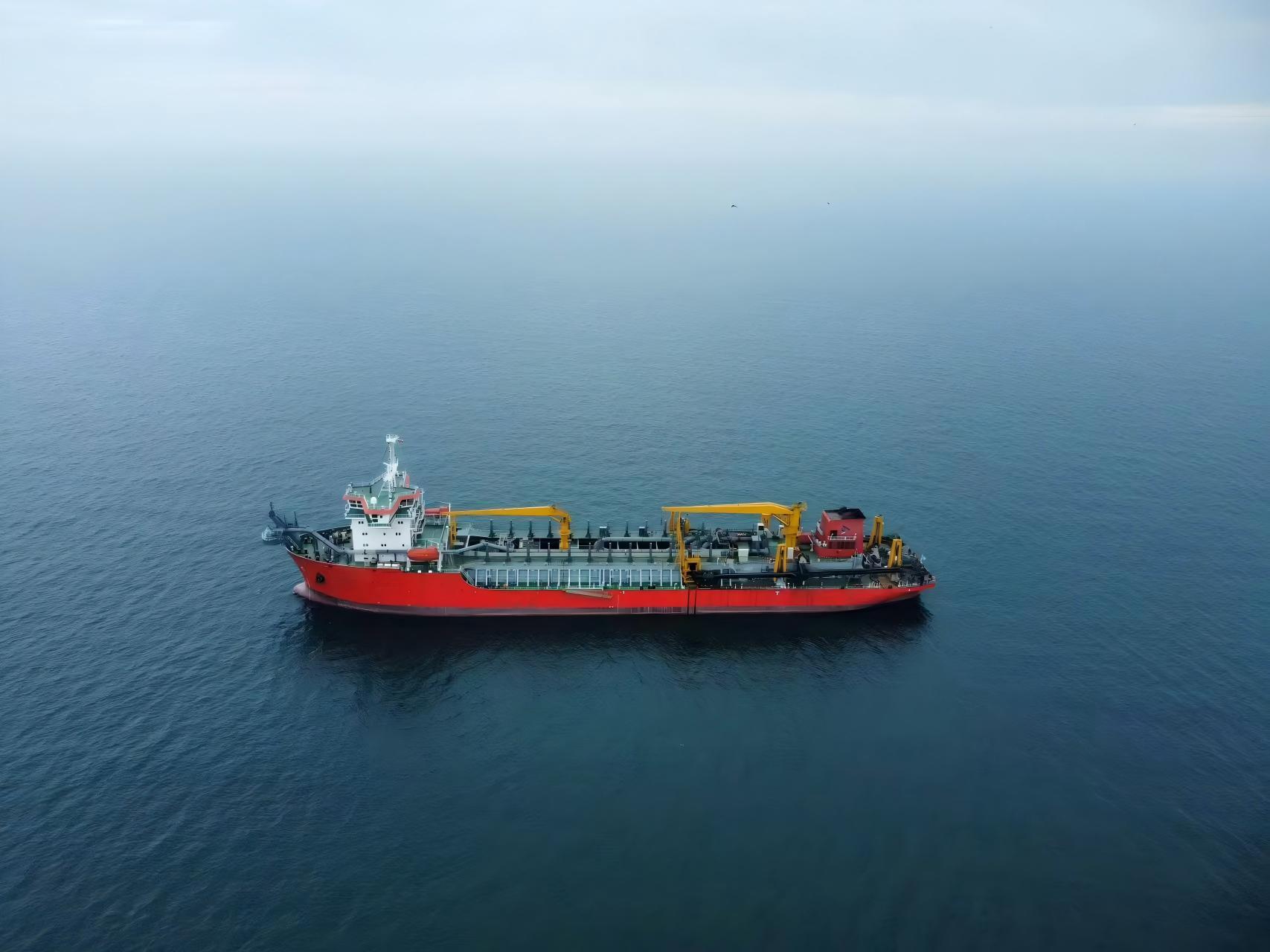
Deep reach is a pumping problem before it is a structural one. Material lifted from 115 m must be raised through a Φ1200 mm suction pipe against a substantial head. The installed arrangement combines 2 × 6,000 kW inboard dredge pumps (HK), 2 × 3,300 kW underwater pumps (HK + BKKER) and 2 × 2,000 kW jet water pumps (CCCC). Jet water assists in loosening and transporting denser material, which matters where the seabed is not clean sand.
4. Power and station-keeping — 27,726 kW installed, DP-1
Total installed power is 27,726 kW. The main diesel engines are three Wartsila units rated 8,000 kW each. Auxiliary and harbour power comes from two Wartsila generators of 1,600 kW, with a Cummins emergency generator of 526 kW. Propulsion and manoeuvring use two Wartsila main thrusters of 10,500 kW, two ZF bow thrusters of 1,100 kW and one ZF stern thruster of 1,100 kW. The DP-1 notation means the vessel can hold position over a dredging location under automatic control — the operational answer to dredging at the deeper end of the envelope in open sea conditions.
5. Classification and compliance — CCS, R1, DP-1, AUT-0
The class notation for this configuration is CCS, CSA Trailing Suction Dredger, dredging within R1, with DP-1. The vessel also carries AUT-0 notation G-P01L1,S,C,RC,NEC2,INC,RSC1,AFS and G-ECO(BWM(T)). For projects where the client's specification or flag requirements call for a different society, Yanyang Marine states that its dredgers can be classed by CCS, BV, LR, DNV or other IACS societies as required.
6. Operating environment and mode
The vessel is designed for offshore and coastal marine operations, including open sea and harsh marine environment conditions. It works in continuous operation, either self-propelled or barge-towed, and depends on a supporting spread of dredge pumps, pipelines, surveying systems and anchor handling equipment. Procurement planning that stops at the hull and omits this spread usually under-budgets the mobilisation phase.
Step-by-Step: Validating this TSHD Against Your Project
The sequence below is the order in which the specification decisions constrain each other. Changing an earlier step invalidates the ones after it.
- Fix the design depth. State the target depth for the deepest section of the works and identify which rated step applies — 40 m, 70 m or 115 m. The rating and pump configuration are matched at design stage, not field-adjusted afterwards.
- Define the material path. Establish where the dredged material goes — reclamation area, disposal site or both — and the sailing distance between dredging ground and discharge point.
- Size the hopper. Compare the approximately 26,800 m³ capacity against required volume per cycle and expected trip count. For smaller scopes within the same fleet, TSHD hopper capacities are available across a 1,100–26,800 m³ range.
- Check access and draft. Confirm that the 9.50 m draft at international freeboard, 171.20 m length over all and 36.00 m moulded breadth are compatible with your channel, turning basin, berth and yard access.
- Confirm station-keeping and sea state. Match DP-1 and the installed thruster power against the exposure of the working area and the duration of the working window.
- Verify class against the project jurisdiction. Confirm CCS with dredging within R1 and DP-1 satisfies the client specification; if a different IACS society is required, raise it at design stage.
- Scope the support train and commissioning. Include dredge pumps, pipelines, surveying systems and anchor handling equipment, then confirm the delivery scope: factory construction and testing, shipping, on-site commissioning and operator training, spare parts supply and worldwide after-sales technical support.
- Set the schedule. Plan around 2–3 months for standard vessels and 8–12 months for custom dredgers, and align the mobilisation window with the marine works programme.
Where This Configuration Fits
- Deep-water channel deepening and maintenance. The 40 / 70 / 115 m envelope covers channel programmes where depth exceeds the reach of standard hopper dredgers.
- Port expansion and large-scale reclamation. High hopper volume per cycle reduces the number of trips required to move a given volume of material, which matters when both sailing distance and working windows are constrained.
- Energy, metallurgy and mineral terminal access. Deep-draft berths depend on channel depth being held to design; capacity per cycle shapes how much of the maintenance programme can be completed inside a dredging season.
- Harsh open-sea programmes. DP-1 positioning, 27,726 kW installed power and thrusters rated up to 2 × 10,500 kW support operation in open sea conditions.
- Regional deployment. Yanyang Marine exports to markets including the United Arab Emirates, Indonesia, India, Egypt, Turkey, Nigeria, South Africa, Tanzania, Saudi Arabia and Oman.
Comparison: Depth and Capacity Envelope Across Dredger Types
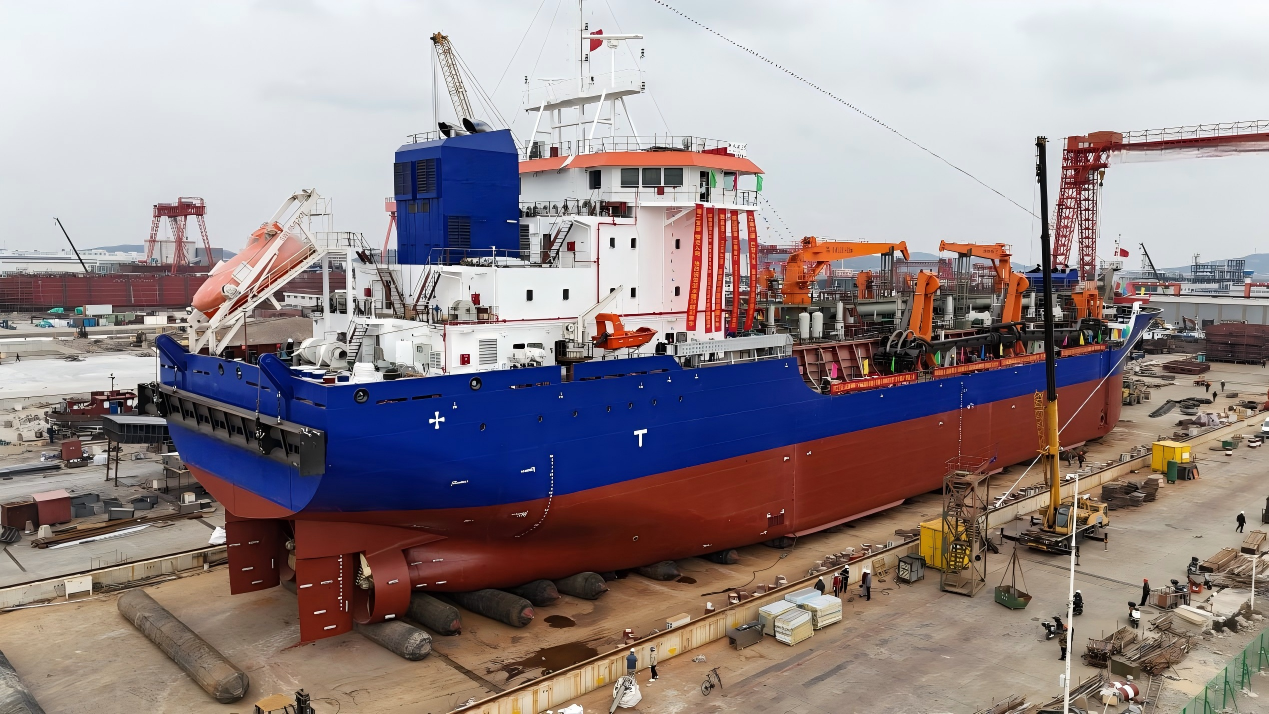
The table below places the 26,800 m³ TSHD alongside other Yanyang Marine dredger configurations, using their documented specifications. It is an envelope reference for early screening, not a substitute for project-specific engineering.
| Vessel type | Documented dredging depth | Documented capacity reference | Documented project fit |
|---|---|---|---|
| Trailing Suction Hopper Dredger (TSHD), 26,800 m³ configuration | 40 / 70 / 115 m | Hopper approx. 26,800 m³; suction pipe Φ1200 mm; 27,726 kW installed power | Deep-water channels, port expansion and large-scale reclamation; intended for harsh open sea conditions |
| Cutter Suction Dredger, 1000–8000 m³/h | 30 m (8000 m³/h self-propelled configuration) | 8,000 m³/h output; 8,000 m discharge distance; LOA 121 m, width 25 m, depth 8.5 m | International container port deepening, trans-oceanic channel excavation, offshore airport construction, coastal reclamation and deep-water berth construction for VLCC tankers |
| Grab Dredger, self-propelled, 25 m³ | Not stated in the configuration data | Grab capacity 25 m³; LOA 58.00 m; navigation area coastal | Removing hard clay and soft sediment in near-shore operations |
| Backhoe Dredger, EX5500 self-propelled | 18 / 24 / 32 m | Bucket capacity 15 / 18 / 20.5 m³; Hitachi EX 5500 excavator; 2 × 1,076 kW | Excavation of stiff material; long-term offshore dredging operations |
Fit Boundaries: When This TSHD Is Not the Right Answer
A 26,800 m³ TSHD is a large capital asset with a defined operating envelope. Stating its limits is part of specifying it correctly.
- Draft and access. At 9.50 m draft at international freeboard, the vessel requires correspondingly deep access. Shallow inland waterways, thin-draft approach channels and restricted locks limit where it can be deployed.
- Hull size in confined areas. A 171.20 m length over all and 36.00 m moulded breadth demand turning basins and berths sized accordingly. Confined harbours and tight working areas are better served by smaller or more manoeuvrable units.
- Low-volume, near-shore work. Where the scope is limited and close to shore — for example removing hard clay and soft sediment in near-shore operations — a smaller grab or backhoe configuration can be proportionate where the deep-water envelope is not required.
- Long onshore discharge distances. Where material must be pumped long distances ashore, discharge distance becomes a governing parameter; the cutter suction dredger configuration documented at 8,000 m discharge distance is the relevant reference point.
- Budget scale. Where project volume does not justify large-hopper economics, TSHD capacity is available across a 1,100–26,800 m³ range, so the depth envelope requirement should be checked before the hopper size is fixed.
Frequently Asked Questions
1. What class and notation does the 26,800 m³ TSHD carry?
The vessel is built to CCS class with the notation CSA Trailing Suction Dredger, dredging within R1, and DP-1. It also carries AUT-0 notation G-P01L1,S,C,RC,NEC2,INC,RSC1,AFS and G-ECO(BWM(T)). DP-1 is relevant on deep-water work because the dredger must hold position over the suction point in open sea conditions. Yanyang Marine states that its dredgers can also be classed by CCS, BV, LR, DNV or other IACS societies when a project specification requires it. At industry level, classification societies publish dredger-specific rules — Bureau Veritas, for example, issues guidelines for the assignment of reduced freeboards for dredgers — and ISO 8384:2019 provides the standard vocabulary for describing dredger types in tender documents.
2. How deep can it dredge, and how much material can it carry per cycle?
The documented dredging depth is 40 / 70 / 115 m, with a suction pipe diameter of Φ1200 mm. Maximum hopper capacity is approximately 26,800 m³. Supporting figures: length over all approximately 171.20 m, length between perpendiculars 160.00 m, moulded breadth 36.00 m, moulded depth 15.80 m, draft at international freeboard 9.50 m, and a service speed of approximately 15.5 knots at 11.5 m draft. Installed power totals 27,726 kW, comprising Wartsila main engines of 3 × 8,000 kW, Wartsila auxiliary/harbour generators of 2 × 1,600 kW, a Cummins emergency generator of 526 kW, Wartsila main thrusters of 2 × 10,500 kW, inboard dredge pumps of 2 × 6,000 kW, underwater pumps of 2 × 3,300 kW and jet water pumps of 2 × 2,000 kW.
3. What drives the cost of a deep-water TSHD, and how does a Chinese-built unit compare?
The main cost drivers are the depth rating of the suction system, hopper volume, installed power (engines, thrusters, dredge pumps and jet water pumps), the class notation package including DP-1, and the degree of customisation. Budget planning should also cover the supporting equipment the vessel depends on — dredge pumps, pipelines, surveying systems and anchor handling equipment — plus commissioning, operator training and spare parts. On commercial positioning, Yanyang Marine states that its products are offered at approximately 50% lower cost compared with European manufacturers, with standard vessels delivered in 2–3 months and custom units on shorter lead times than bespoke European newbuilds.
4. Can a project validate the vessel configuration before construction is committed?
Validation runs through configured design, documentation and factory testing. Yanyang Marine works in ODM and custom-made mode, sizing dredging depth, output capacity, working environment and configuration to the project, and offers TSHD hopper capacities from 1,100 m³ to 26,800 m³, with ready stock available for some sizes. The delivery scope covers custom design and engineering, factory construction and testing, shipping and global delivery, on-site commissioning and operator training, long-term spare parts supply, and worldwide after-sales technical support for new building as well as maintenance, repair and conversion work.
5. What lead time should be planned for this TSHD?
Yanyang Marine quotes 2–3 months for standard vessels and 8–12 months for custom dredgers. A 26,800 m³ vessel with a 115 m depth rating, DP-1 notation and a specific class package should be planned as a custom newbuild. To start a configuration review, send the design depth, soil profile, hopper requirement and delivery window to Info@yanyangmarine.com or contact the team on WhatsApp at +86 159-5290-0547.
Conclusion: Specify Reach and Volume Together
Deep-water programmes break at the seam between reach and volume. The 26,800 m³ TSHD closes that seam with a single hull: a 40 / 70 / 115 m dredging depth envelope, approximately 26,800 m³ of hopper capacity, a Φ1200 mm suction pipe, 27,726 kW of installed power and CCS class with DP-1 — all supported by a documented operating requirement for dredge pumps, pipelines, surveying systems and anchor handling equipment.
For project managers and procurement specialists in the energy, metallurgy and mineral sectors, the sequence is straightforward: fix the design depth, define the material path, size the hopper, check access and draft, confirm class against the project jurisdiction, and scope the support train and commissioning together with the delivery schedule. Yanyang Marine builds trailing suction hopper dredgers, cutter suction dredgers, backhoe dredgers, grab dredgers, split hopper barges and pile driving barges, and can be classed by IACS societies including CCS, BV, LR and DNV.
Request a Configuration Review for Your Project
Send your design depth, soil profile, hopper requirement and delivery window to receive a tailored TSHD configuration and quotation.
Contact: Liao | Email: Info@yanyangmarine.com | Tel / WhatsApp: +86 159-5290-0547
Office: 1# Rainbow Building, Jiangbin Road, Zhenjiang City, Jiangsu Province, China | www.yanyangmarine.com
Have Questions or Need More Details?
Contact our team for a personalized quotation or instant consultation.
Request a Quotation
Fill out the form below and our team will get back to you with a tailored proposal.
WhatsApp Direct Chat
Prefer to chat in real-time? Message us on WhatsApp for instant assistance & quick answers.
- Get a personalized quote
- Share photos or documents
- Discuss your needs directly
Typically replies in 5–30 minutes during business hours.