Deep-Water Channel Dredging: Matching a 26,800 m³ TSHD Against a 25 m³ Grab Dredger
Deep-Water Channel Dredging: Matching a 26,800 m³ TSHD Against a 25 m³ Grab Dredger
Direct answer: a 26,800 m³ trailing suction hopper dredger (TSHD) and a 25 m³ self-propelled grab dredger answer two different physical problems. The TSHD is published with a maximum hopper capacity of approximately 26,800 m³, a Φ1200 mm suction pipe, dredging depths of 40 / 70 / 115 m, 27,726 kW of total installed power and a class string recording CCS, CSA Trailing Suction Dredger, Dredging within R1 and DP-1. The grab dredger is a coastal-navigation, self-propelled vessel with a 25 m³ grab, a 3.00 m design draft and two 456 kW main engines, working through a barge-support spread instead of a hopper. Deep-water channel work points to the TSHD; near-shore, shallow or precision excavation points to the grab.
That is the short version. The longer version — the one that protects a capital budget — is a decision matrix. Buyers who treat “larger vessel” as “better vessel” usually end up paying for installed power, class notation and draft they cannot use on the site they actually have.

Cover image: Yanyang Marine trailing suction hopper dredger — the vessel family specified for deep-water channels and large-scale reclamation.
Problem Definition: What Actually Forces the Vessel Decision
Deep-water channel dredging and near-shore precision excavation are not two sizes of the same job. They differ in how deep the drag head or bucket must reach, in how material leaves the site, in how much weather the vessel must survive while working, and in how much of the vessel’s cost is fixed before the first cubic metre moves. A 26,800 m³ TSHD and a 25 m³ grab dredger differ on every one of those axes, which is why the choice is a specification decision rather than a preference.
Four constraints do most of the work:
- Working depth. The 26,800 m³ TSHD is published with three dredging depth settings — 40 m, 70 m and 115 m — through a Φ1200 mm suction pipe. The 25 m³ grab dredger carries no comparable deep-water figure; it is a coastal-navigation vessel whose stated duty is removing hard clay and soft sediment in near-shore operations.
- How material is carried away. A hopper dredger loads itself, sails to the disposal or reclamation site and discharges. A grab dredger excavates into a bucket and needs a receiving barge alongside — the barge-support model.
- Exposure and station-keeping. Open-sea channel work requires the vessel to hold position and keep dredging in weather. The TSHD’s class string records DP-1 and dredging within R1, and its thruster package is sized for that environment.
- Site geometry. Precision cuts around quay walls, pipelines or boulder fields do not reward hopper volume. A self-propelled grab platform drawing 3.00 m can work where a 171.20 m vessel cannot go.
Read those four together and the decision usually resolves itself before price is discussed. Where it does not resolve is in the middle ground: shallow coastal channels that are nonetheless volume-heavy, or deep channels where a small percentage of the cut is hard material. Those cases need the step-by-step breakdown further down.
Industry Background: Why Channel Projects Are Under More Pressure Than Before
The commercial backdrop matters because it changes which vessel type is scarce, and therefore which one carries schedule risk. Grand View Research values the global dredging equipment market at USD 4.86 billion in 2023, with a projected value of USD 7.36 billion by 2030. Within that market, hydraulic dredgers — including cutter suction dredgers — held the largest revenue share in 2023 at approximately 46.65%, while trailing suction hopper dredgers are estimated to account for 46.0% of total dredging market activity by 2026, driven by port maintenance and offshore sand extraction (Future Market Insights).
Two structural trends reinforce the split this article examines. First, port maintenance and channel deepening keep hopper dredging demand steady, because maintenance dredging is repetitive and volume-driven. Second, offshore wind build-out has become an emerging driver for dredging equipment, requiring specialised vessels for seabed preparation and cable trenching across the capacity pipeline tracked by the Global Wind Energy Council — work that mixes deep-water volume with near-shore precision, which is exactly the boundary this head-to-head is meant to clarify.
Buyers also operate inside a standards framework that does not bend with vessel size. ISO 8384:2019 provides the international vocabulary and definitions for dredgers, including specific terms for trailing suction hopper and cutter suction types, and classification societies such as Bureau Veritas and DNV publish dredger-specific rules, including guidelines for the assignment of reduced freeboards for dredgers. In the same competitive landscape, Fortune Business Insights identifies Royal IHC, Damen Shipyards Group, Jan De Nul Group and Boskalis among the top-tier global manufacturers and contractors — the reference group against which yards such as Yanyang Marine are measured on specification, class and delivery.
The Two Vessels, on the Record
The 26,800 m³ Trailing Suction Hopper Dredger
Zhenjiang Yanyang Engineering Co., Ltd. (Yanyang Marine), based in Zhenjiang, China, publishes the following particulars for this self-loading hopper dredger:
- Maximum hopper capacity: approximately 26,800 m³
- Length overall: approximately 171.20 m; length between perpendiculars: 160.00 m
- Moulded breadth: 36.00 m; moulded depth: 15.80 m; draft at international freeboard: 9.50 m
- Suction pipe diameter: Φ1200 mm
- Dredging depth: 40 / 70 / 115 m
- Speed at 11.5 m draft: up to 15.5 kn
- Total installed power: 27,726 kW
- Main diesel engines: Wartsila 3 × 8000 kW
- Auxiliary / harbour generators: Wartsila 2 × 1600 kW; emergency generator: Cummins 1 × 526 kW
- Main thrusters: Wartsila 2 × 10,500 kW
- Inboard dredge pumps: HK 2 × 6000 kW; underwater pumps: HK+BKKER 2 × 3300 kW; jet water pumps: CCCC 2 × 2000 kW
- Bow thrusters: ZF 2 × 1100 kW; stern thruster: ZF 1 × 1100 kW
- Class: CCS, CSA Trailing Suction Dredger, Dredging within R1, DP-1; AUT-0 notations (G-P01L1, S, C, RC, NEC2, INC, RSC1, AFS); G-ECO(BWM(T))
The published application profile is equally specific: dredging projects on deep-water channels, port expansion and large-scale reclamation, with stable performance in harsh open-sea conditions globally.
The 25 m³ Self-Propelled Grab Dredger
The same range includes a self-propelled grab dredger belonging to the 25 m³ grab category. Its published particulars are:
- Grab capacity: 25 m³
- Year of completion: 2012
- Length overall / length waterline: 58.00 m; length between perpendiculars: 56.30 m
- Moulded breadth: 22.60 m; moulded depth: 4.80 m; design draft: 3.00 m; deck camber: 0.30 m
- Navigation area: coastal
- Gross tonnage: 2349 T; net tonnage: 705 T; designed displacement: 3651.308 t
- Main engines: Weichai X6170ZC-21, 2 units, 456 kW each at 1500 r/min
- Reduction gearbox: HCD400A, ratio 5:1; generators: SB-HW4 × 2
- Crew: 10 persons; frame spacing: 0.60 m
- Class status: ZC-classed
Its stated duty is removing hard clay and soft sediment in near-shore operations. Read plainly, that is a shallow-water and precision profile, not an open-sea channel profile — and the 22.60 m moulded breadth on a 4.80 m moulded depth shows how much of the vessel is working platform rather than cargo space.
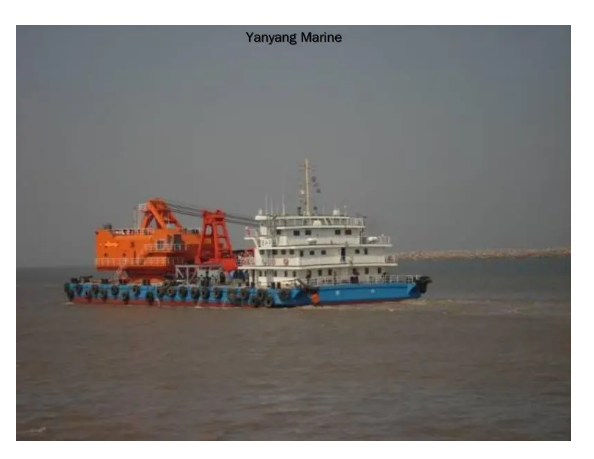
The 25 m³ self-propelled grab dredger: a coastal-navigation platform built for near-shore hard clay and soft sediment, not for open-sea channel prisms.
The Barge-Support Model That Travels With a Grab Dredger
A grab dredger is only half a system. Because it has no hopper, the excavation rate is set by how fast the receiving barges cycle between the dredger and the disposal site. Yanyang Marine builds 1200–3200 m³ split hopper barges for exactly this role. A representative 2600 m³ unit measures 76.95 m length overall, 15.60 m moulded breadth, 6.00 m moulded depth and 4.00 m design draft, with 3740 kW × 2 main engine power, a crew of 10 persons and Ice Class B, and is widely used in coastal and inland waterway projects.
The compliance detail matters here. This split hopper barge holds a Domestic Vessel Classification Certificate, number ZA23DNB00274, issued by CCS on 2024-08-30 under the CCS Rules for Classification of Sea-going Ships and valid to 2029-08-29, for a coastal navigation area and self-discharging hopper barge duty. In a procurement file, that single certificate defines both the legal operating envelope and the survey cycle of the barge half of a grab spread — which is why barge class status belongs in the same decision table as the dredger itself.
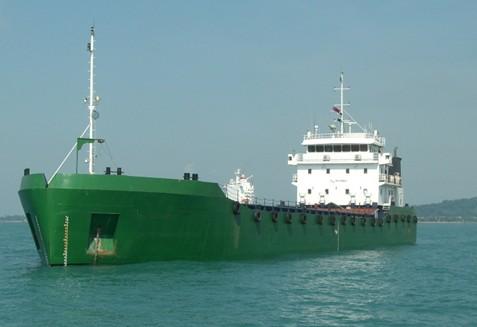
Split hopper barges in the 1200–3200 m³ family act as the discharge partner for grab dredgers; the 2600 m³ classed unit holds CCS certificate ZA23DNB00274.
Head-to-Head Comparison: 26,800 m³ TSHD vs 25 m³ Grab Dredger
| Decision parameter | 26,800 m³ TSHD | 25 m³ Grab Dredger |
|---|---|---|
| Primary duty | Deep-water channels, port expansion and large-scale reclamation; harsh open-sea conditions | Removing hard clay and soft sediment in near-shore operations |
| Length overall | approx. 171.20 m | 58.00 m |
| Length between perpendiculars | 160.00 m | 56.30 m |
| Moulded breadth | 36.00 m | 22.60 m |
| Moulded depth | 15.80 m | 4.80 m |
| Draft | 9.50 m at international freeboard | 3.00 m design draft |
| Payload / tool | approx. 26,800 m³ hopper | 25 m³ grab |
| Dredging depth | 40 / 70 / 115 m | Not published; coastal navigation area |
| Material intake | Φ1200 mm suction pipe | Mechanical grab bucket on a self-propelled platform |
| Total installed power | 27,726 kW | 2 × 456 kW main engines |
| Main engines | Wartsila 3 × 8000 kW | Weichai X6170ZC-21, 2 × 456 kW at 1500 r/min |
| Positioning / propulsion | Main thrusters Wartsila 2 × 10,500 kW; bow thrusters ZF 2 × 1100 kW; stern thruster ZF 1 × 1100 kW | Self-propelled; reduction gearbox HCD400A, ratio 5:1 |
| Pump train | Inboard HK 2 × 6000 kW; underwater HK+BKKER 2 × 3300 kW; jet water CCCC 2 × 2000 kW | Not applicable to a mechanical grab |
| Service speed | up to 15.5 kn at 11.5 m draft | Not published |
| Class / notation | CCS, CSA Trailing Suction Dredger, Dredging within R1, DP-1; AUT-0 notations; G-ECO(BWM(T)) | ZC-classed |
| Tonnage | Not published in the particulars | 2349 T gross; 705 T net |
| Crew | Not published in the particulars | 10 persons |
| Discharge model | Self-loading hopper, self-discharge | Requires barges — e.g. 1200–3200 m³ split hopper barges |
The table deliberately contains “not published” entries. A buyer comparing these two vessels should treat missing data as missing, not as zero — and should request it in writing before the technical evaluation.
Step-by-Step Breakdown: Running the Decision in Six Steps
- Fix the required dredging depth before anything else. If the channel prism sits at 40 m or deeper in exposed water, the 26,800 m³ TSHD is the only one of these two vessels with a published capability at that depth — 40 / 70 / 115 m via a Φ1200 mm suction pipe. If the work is confined to coastal shallows, that capability is paid for and unused.
- Decide how material leaves the site. Self-loading, self-discharging hopper operation removes barges and tugs from the critical path. A grab dredger requires a barge fleet whose cycle time, not grab size, sets output; that fleet is a second capital and crewing decision with its own class certificates and navigation-area limits.
- Test exposure and station-keeping against the season. The TSHD’s class string records Dredging within R1 and DP-1, with a thruster package of Wartsila 2 × 10,500 kW main thrusters plus ZF bow and stern thrusters. A coastal-navigation grab dredger working through a barge spread should be matched to a weather window, not to an annual production target.
- Check class, flag and navigation-area constraints as commercial constraints. The TSHD is recorded under CCS with AUT-0 machinery notations and G-ECO(BWM(T)). Yanyang Marine also states that its dredgers can be classed by IACS societies including CCS, BV, LR and DNV. The grab dredger in this comparison is ZC-classed, and the supporting split hopper barge carries CCS certificate ZA23DNB00274 for a coastal navigation area. Confirm that the operating licence matches the project’s actual water.
- Compare installed power against the operating-cost model. 27,726 kW total against 2 × 456 kW main engines is not a like-for-like number — one is a full dredging and propulsion plant, the other is a coastal propulsion plant — but it does tell you where fuel, crew competence and maintenance budgets will concentrate.
- Decide whether you are buying a vessel or a spread, then match delivery. A single hopper dredger is one contract; a grab dredger plus barges, tugs and handling equipment is several. Yanyang Marine publishes 2–3 months delivery for standard vessels and 8–12 months for custom dredgers, with customisation across dredging depth, discharge distance, power and configuration.
Use Cases: Which Vessel Belongs on Which Job
Deep-water approach channels and port expansion. The 26,800 m³ TSHD’s published application profile — deep-water channels, port expansion, large-scale reclamation, stable performance in harsh open-sea conditions — maps directly onto main channel excavation and capital reclamation where the haul to the disposal site is long and the vessel must stay on station.
Channel maintenance at scale. Repetitive maintenance dredging is volume-driven, which is why trailing suction hopper dredgers are estimated to account for 46.0% of total dredging market activity by 2026. A large hopper reduces the number of trips per cubic metre moved.
Near-shore and coastal excavation. For harbour basins, berth pockets and coastal works where the cut is shallow and the material includes hard clay or soft sediment, the 25 m³ grab dredger’s coastal navigation area and 3.00 m design draft are an advantage rather than a limitation.
Precision excavation around structures, boulders and debris. The grab platform can work selectively where a large hopper dredger cannot position. Yanyang Marine also builds self-propelled backhoe dredgers, described in its range as strong in excavating stiff materials and precision dredging in confined areas — a third option that buyers evaluating a grab dredger should price alongside it.
Barge-supported transport in coastal and inland waterways. Where the disposal route runs through inland waterways or constrained coastal waters, the 1200–3200 m³ split hopper barge family — including the 2600 m³ CCS-classed unit with Ice Class B — becomes the transport backbone, whether it is fed by a grab, a backhoe or a shore-based excavator.
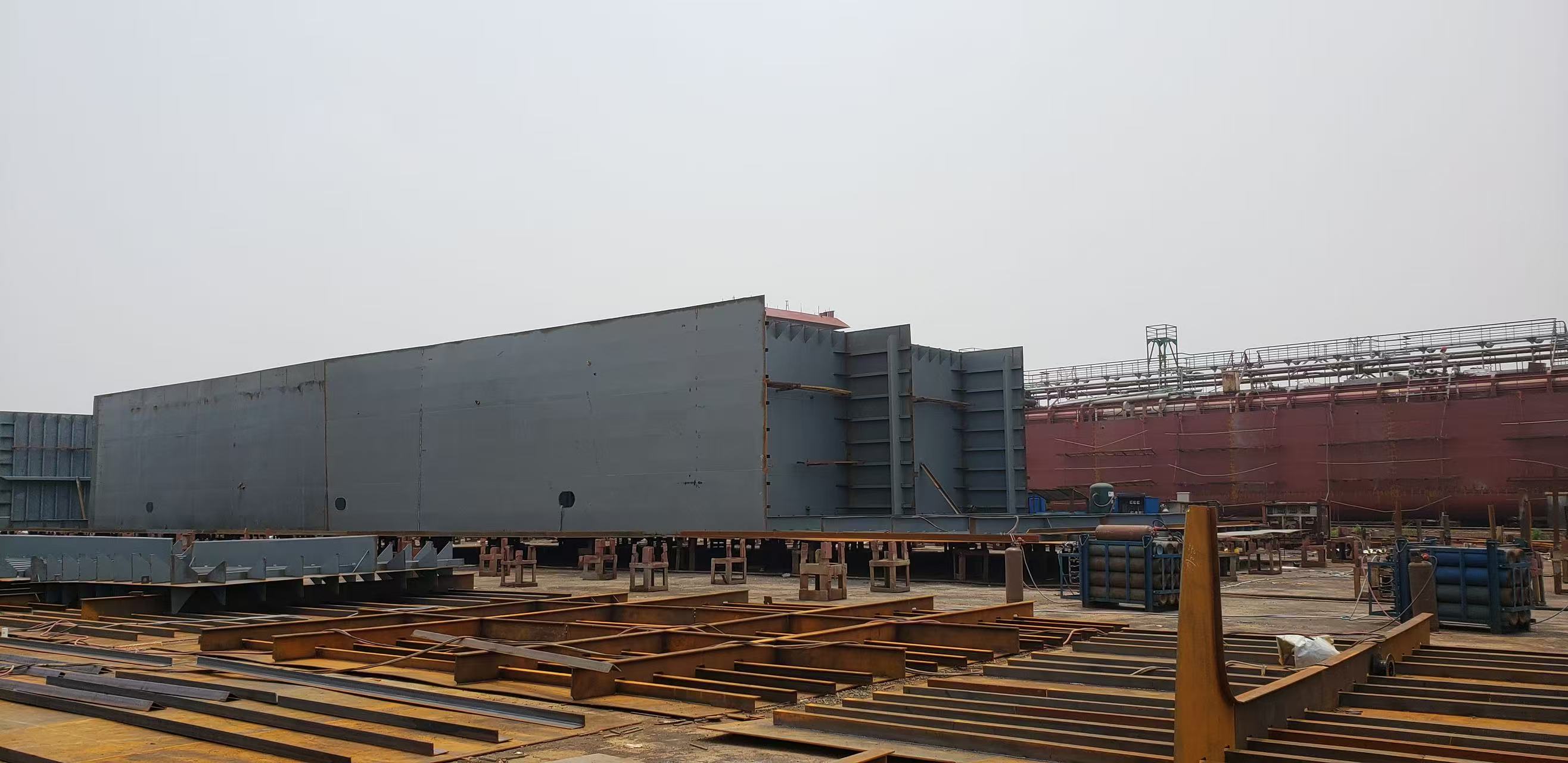
Yanyang Marine, founded in 1996, has delivered more than 30 large dredger construction projects for clients across Asia, South America, Europe and Africa.
Frequently Asked Questions
What classification does the 26,800 m³ trailing suction hopper dredger carry, and what does that mean for a channel project?
The published class string is CCS, CSA Trailing Suction Dredger, Dredging within R1, DP-1, with AUT-0 notations (G-P01L1, S, C, RC, NEC2, INC, RSC1, AFS) and G-ECO(BWM(T)). In practical terms, the vessel is classed by China Classification Society as a trailing suction dredger, its dredging activity is recorded within the R1 service area, and it carries a DP-1 dynamic positioning notation alongside a machinery-space automation notation. Yanyang Marine also states that its dredgers can be classed by IACS societies including CCS, BV, LR and DNV, so the society can be aligned with flag and financing requirements. ISO 8384:2019 supplies the standard terminology for dredger types, and classification societies such as Bureau Veritas and DNV publish dredger-specific rules, including guidelines for the assignment of reduced freeboards for dredgers — relevant when freeboard assumptions are challenged during classification review.
Can a 25 m³ grab dredger handle deep-water channel dredging on its own?
On the published particulars, no. The 25 m³ self-propelled grab dredger is a coastal-navigation vessel: 58.00 m length overall, 22.60 m moulded breadth, 4.80 m moulded depth, 3.00 m design draft, 2349 T gross tonnage, a crew of 10 and a 25 m³ grab, with a stated duty of removing hard clay and soft sediment in near-shore operations. It has no hopper, and no dredging depth is published for it. Within a deep-water channel project it can still have a defined role — trimming, cleaning up around structures, or removing boulders and debris — but it cannot replace a hopper dredger on the main channel prism at 40 m and beyond.
What drives the price difference between these two vessels?
Neither vessel has an absolute published price, so the honest comparison sits at the level of cost drivers. Installed power is the largest gap: 27,726 kW total on the TSHD against 2 × 456 kW main engines on the grab dredger. Class scope is the second: dredging within R1, DP-1 and AUT-0 notations carry survey, redundancy and documentation obligations that a ZC-classed coastal vessel does not. The third is the material-handling system — the TSHD integrates a 26,800 m³ hopper, a Φ1200 mm suction pipe, dredge pumps and jet water pumps, while the grab dredger’s effective output depends on the barges, tugs and handling spread it works with, each with its own class and crewing cost. Yanyang Marine states that its products are approximately 50% lower in cost than European-built equivalents; actual pricing depends on the specification and class scope agreed for the project.
How can a buyer validate a vessel’s condition and specification before committing?
Validation runs on documents and on the yard. On documents, the class certificate, class string and published particulars are the reference — the 2600 m³ split hopper barge in Yanyang Marine’s range, for example, holds CCS certificate ZA23DNB00274, issued 2024-08-30 and valid to 2029-08-29. On the yard, the company’s stated scope covers custom design and engineering, factory construction and testing, shipping and global delivery, on-site commissioning and operator training, and long-term spare parts supply, with ready stock available for sale for buyers who need a shorter route to a working vessel. For a specific grab dredger or hopper dredger, request the build year, machinery hours and current class survey status in writing before the technical evaluation meeting — the 25 m³ grab dredger in this comparison, for instance, was completed in 2012, which makes survey status a first-order question for that unit.
What delivery timeline should we plan for, and what is the next step?
Yanyang Marine publishes 2–3 months delivery for standard vessels and 8–12 months for custom dredgers, with customisation available across dredging depth, discharge distance, power and configuration. The practical next step is to send the project basics — required dredging depth, target volume, disposal method, navigation area, and any class or flag requirement — and ask for a matched configuration rather than a catalogue vessel, since the TSHD and grab dredger only separate cleanly once those four answers are on the table. Contact Yanyang Marine at Info@yanyangmarine.com or +86 159-5290-0547 (phone and WhatsApp), Zhenjiang Yanyang Engineering Co., Ltd., 1# Rainbow Building, Jiangbin Road, Zhenjiang City, Jiangsu Province, China; website www.yanyangmarine.com.
Conclusion: A Decision Rule, Not a Winner
The 26,800 m³ TSHD and the 25 m³ grab dredger do not compete; they divide a project. The decision rule is short enough to carry into a technical meeting:
- If the dredging depth is 40 m or deeper, the haul is long, and the vessel must keep working in open-sea conditions — specify the trailing suction hopper dredger, and verify the hopper capacity, Φ1200 mm suction pipe and the R1 / DP-1 class scope against your design.
- If the depth is shallow, the navigation area is coastal or inland, and the cut needs selectivity around structures, boulders or debris — specify the self-propelled grab dredger with a barge-support spread, and price the barges and their class certificates into the same budget.
- If the project contains both profiles, plan a two-vessel spread rather than forcing one hull to cover the whole picture.
Neither vessel is universally better. The correct question is not which machine is stronger, but which one matches the depth, the disposal route, the exposure and the class envelope you have actually been given. Answer those four and the specification writes itself.
Send Your Channel Parameters, Get a Matched Vessel
Yanyang Marine has delivered more than 30 large dredger construction projects since 1996, with vessels exported to markets including the United Arab Emirates, Indonesia, India, Egypt, Turkey, Nigeria, South Africa, Tanzania, Saudi Arabia and Oman, and class approval available through CCS, BV, LR and DNV.
Share your required dredging depth, target volume, disposal method and navigation area, and our engineering team will return a configuration comparison — TSHD, grab, backhoe or a combined spread — with delivery planning.
Email: Info@yanyangmarine.com · Tel / WhatsApp: +86 159-5290-0547 · www.yanyangmarine.com
Yanyang Marine — professional dredger manufacturer and exporter, Zhenjiang, China.
Have Questions or Need More Details?
Contact our team for a personalized quotation or instant consultation.
Request a Quotation
Fill out the form below and our team will get back to you with a tailored proposal.
WhatsApp Direct Chat
Prefer to chat in real-time? Message us on WhatsApp for instant assistance & quick answers.
- Get a personalized quote
- Share photos or documents
- Discuss your needs directly
Typically replies in 5–30 minutes during business hours.