Decoding Dredging Equipment Technical Parameters: How Production Quality Influences Performance and Longevity
Decoding Dredging Equipment Technical Parameters: How Production Quality Influences Performance and Longevity
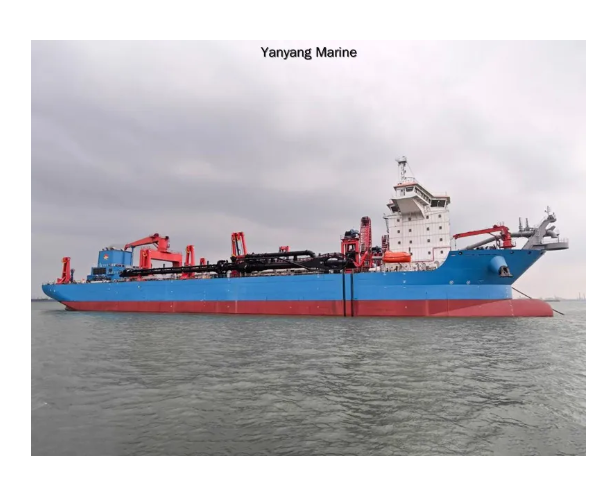
Figure 1: A modern Trailing Suction Hopper Dredger – understanding its specs is key to successful procurement.
Introduction
Purchasing dredging equipment involves far more than comparing price tags. Procurement professionals, project managers, and fleet owners must interpret complex technical parameters and understand how manufacturing processes ultimately determine the vessel’s real-world performance and service life. This article deciphers the most critical dredging equipment technical parameters and reveals how production quality—from steel selection to final classification—directly impacts operational efficiency, maintenance costs, and asset longevity. Using real-world examples from established manufacturer Zhenjiang Yanyang Engineering Co., Ltd. (Yanyang Marine), we provide a practical framework for informed decision-making.
Problem Definition: Why Technical Specifications Are Often Misunderstood
A common pain point for buyers is receiving a data sheet full of figures—dredging depth, hopper capacity, installed power—without understanding which numbers truly matter for their specific project. Misinterpreting these parameters can lead to:
- Incorrect equipment selection – e.g., choosing a dredger with insufficient power for hard soil.
- Unforeseen performance bottlenecks – such as low production rates or inability to achieve required discharge distance.
- Accelerated wear and failure – because the vessel’s structural design or component quality cannot withstand the operating environment.
Furthermore, even when specifications appear ideal, the manufacturing quality (welding standards, pump assembly precision, corrosion protection) can turn a capable design into a maintenance nightmare. The challenge is not only “what do these numbers mean?” but also “how can I trust that the final product delivers the numbers?”
Industry Background: The Global Dredging Equipment Market
The global demand for dredging equipment continues to grow, driven by port expansion, land reclamation, channel deepening, offshore wind farm construction, and river desilting. Buyers today have multiple options: European legacy brands (e.g., IHC, Damen) known for premium quality but at significantly higher cost and longer lead times, and Asian manufacturers such as Yanyang Marine (Zhenjiang, China), which offer 50% lower cost and faster delivery (2–3 months for standard vessels) while still meeting IACS classification standards. A key differentiator is the ability to interpret technical parameters correctly and verify that the manufacturing process ensures compliance with those parameters.
Yanyang Marine, founded in 1996, has delivered over 30 large dredger construction projects to clients in the Middle East, Southeast Asia, Africa, and Europe. Their fleet includes Cutter Suction Dredgers (CSD), Trailing Suction Hopper Dredgers (TSHD), Backhoe Dredgers, Grab Dredgers, and specialized vessels. Many of their vessels are CCS-classed, providing third-party quality assurance.
Detailed Solution: How to Read Dredging Equipment Technical Parameters
Below we break down the most critical parameters, grouped by relevance, and explain their real-world implications. All examples are drawn from Yanyang Marine products to illustrate concrete values.
1. Production Capacity (m³/h vs. m³ per cycle)
For Cutter Suction Dredgers, the key figure is the hourly production rate. Yanyang’s CSD models range from 1,000 to 8,000 m³/h. The higher the rate, the faster the project completion. However, capacity must be matched to dredging depth and discharge distance. A CSD with 8,000 m³/h capacity, 30 m dredging depth, and 8,000 m discharge distance is suited for large-scale port construction and reclamation (as per Yanyang specification). For smaller rivers, a 1,000 m³/h unit is more economical.
For Trailing Suction Hopper Dredgers, the hopper capacity (e.g., 26,800 m³ on Yanyang’s largest TSHD) determines how much material can be loaded before sailing to the disposal site. Combined with suction pipe diameter (Φ1200 mm) and dredging depth (40/70/115 m), this defines the efficiency of open-sea channel dredging.
2. Total Installed Power (kW)
This is a direct indicator of a dredger’s ability to pump material over long distances and handle tough materials. Yanyang’s 26,800 m³ TSHD boasts a total installed power of 27,726 kW, comprising:
- Main diesel engines: Wärtsilä 3 × 8,000 kW
- Main thruster: Wärtsilä 2 × 10,500 kW
- Inboard dredge pump: HK 2 × 6,000 kW
- Bow thrusters: ZF 2 × 1,100 kW
- Emergency generator: Cummins 1 × 526 kW
Understanding power distribution helps buyers evaluate which components are critical for their operation. A higher pump power directly improves discharge distance and resistance to clogging.
3. Dredging Depth and Discharge Distance
These two parameters define the vessel’s working envelope. For the Yanyang CSD, dredging depth is 30 m and discharge distance 8,000 m. For the TSHD, suction pipes can operate at depths of 40/70/115 m depending on configuration. Buyers must verify that the dredging depth matches the column of water at their project site, and that the discharge distance covers the required placement area without additional booster pumps.
4. Excavator / Cutter Power (for Backhoe & Grab Dredgers)
Yanyang’s Backhoe Dredger EX5500 uses a Hitachi EX 5500 excavator with 2 × 1,076 kW (total 2,152 kW). This power, combined with bucket capacity (15/18/20.5 m³) and maximum dredging depth (18/24/32 m), determines the machine’s ability to dig stiff clay or rock. The self-propelled design (propulsion power 2 × 350 kW) adds mobility.
For Grab Dredgers, the grab capacity (e.g., 25 m³ on Yanyang’s model) and the crane’s lifting power are primary. The Yanyang 25 m³ grab dredger is ZC-classed, with a main engine (Weichai 2 × 456 kW) and designed displacement of 3,651 t.
5. Classification and Certification
Classification by an IACS member (e.g., CCS, BV, LR, DNV) assures that the vessel’s design, materials, and construction meet rigorous international standards. Yanyang’s vessels can be classed with CCS, and specific units hold certificates such as Domestic Vessel Classification Certificate No. ZA23DNB00274, issued by CCS in 2024, valid through 2029. This certificate covers coastal navigation and self-discharging hopper barges. Compliance with CCS Rules for Classification of Sea-going Ships means the hull structure, piping, electrical systems, and fire safety have been reviewed and approved.
How Production Quality Affects Performance: A Process View
Even perfect specifications fail if the manufacturing process is flawed. Here are critical production stages that directly impact equipment quality:
Steel Procurement & Plate Preparation
High-strength, corrosion-resistant steel (e.g., marine-grade AH36) is essential for hull longevity. Reputable manufacturers like Yanyang source certified steel and conduct ultrasonic testing before cutting. Poor steel can lead to cracks in high-stress areas.
Welding & Fabrication
Welding quality determines the vessel’s structural integrity. Yanyang follows CCS welding procedures, using qualified welders and performing non-destructive testing (X-ray, MPI) on critical seams. Inferior welding can cause fatigue failure under cyclic dredging loads.
Pump System Assembly & Alignment
The dredge pump is the heart of a CSD or TSHD. Yanyang’s TSHD uses HK inboard dredge pumps (2 × 6,000 kW) and HK + BKKER underwater pumps (2 × 3,300 kW). Proper alignment and impeller balancing reduce vibration and extend pump life. Misalignment can reduce efficiency by 15–20%.
Pipework & Valve Systems
Abrasion-resistant pipe linings and correctly sized valves are critical for long discharge distances. The TSHD’s suction pipe diameter of Φ1200 mm must be matched to the pump capacity. During manufacturing, Yanyang performs pressure tests and flow simulations.
Pre-Delivery Inspection & Sea Trials
Before shipment, every vessel undergoes a Pre-Delivery Inspection (PDI) and PODA signing. Yanyang invites buyers to inspect the vessel at the yard. Sea trials verify speed (e.g., TSHD service speed 15.5 kn at 11.5 m draft), maneuvering, pump performance, and automation (AUT-0 class). A structured acceptance process minimizes post-delivery disputes.
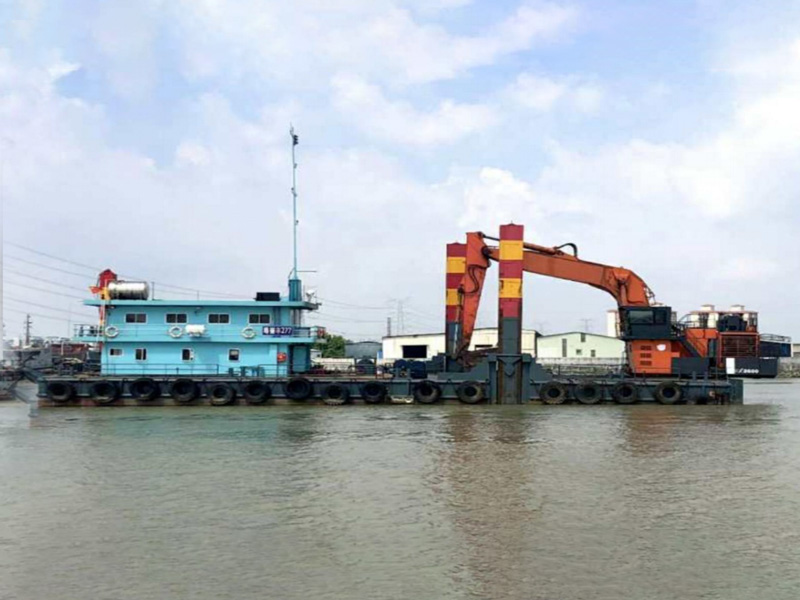
Figure 2: Backhoe Dredger assembly – careful integration of excavator and hull ensures rated digging power.
Step-by-Step: How to Evaluate a Dredger’s Technical Data & Manufacturing Quality
- Define project requirements – material type (sand, clay, rock), required production rate, dredging depth, disposal distance, operating environment (coastal/inland).
- Match dredger type – CSD for continuous high-volume; TSHD for open-sea flexibility; Backhoe for precision in stiff material; Grab for deep-water debris removal.
- Verify key parameters – e.g., for a port deepening project requiring 5 million m³ removal, a CSD with 4,000 m³/h (Yanyang CCS-classed model) might be ideal. Confirm dredging depth > required depth.
- Examine component quality – ask for pump brand (HK, BKKER, Wärtsilä?), engine supplier, and steel grade. Check that the manufacturer provides certificates for major components.
- Check classification – enforce IACS class (CCS, BV, LR, DNV). Class is the best guarantee of design and construction compliance.
- Inspect manufacturing facility – visit the yard (e.g., Yanyang’s facilities in Zhenjiang) to see welding quality, housekeeping, and testing equipment. Request photos or video of recent builds.
- Review after-sales support – ensure the supplier offers global commissioning, training, and spare parts. Yanyang provides long-term support and can have engineers accompany the vessel.
Use Cases: Real-World Application of Technical Knowledge
Case 1: Port Expansion Using CSD
A Middle Eastern port authority needed to deepen berths to accommodate VLCCs. They selected a Yanyang 4,000 m³/h CCS-classed CSD with 30 m dredging depth. The production rate matched the tight schedule, and the CCS certificate satisfied local regulatory requirements. The vessel’s robust pump system (powered by Wärtsilä engines) maintained high discharge over 5 km.
Case 2: Channel Maintenance with TSHD
An Indonesian contractor purchased a used Yanyang TSHD (8,600 m³ hopper) for annual channel maintenance. The vessel’s automated controls (AUT-0) allowed minimal crew, reducing operational cost. The Wärtsilä propulsion and ZF bow thrusters provided excellent maneuverability in narrow channels.
Case 3: River Desilting with Grab Dredger
A Nigerian client used a Yanyang ZC-classed 25 m³ grab dredger to remove hard clay and debris from a river that feeds a hydroelectric plant. The 3,651 t displacement and deep-grab capability (up to 50 m) allowed efficient removal without damaging the riverbed.
Frequently Asked Questions (FAQ)
Q: What is the most important parameter for a Cutter Suction Dredger?
A: The combination of production rate (m³/h) and dredging depth. Ensure both meet your project’s profile. A CSD with 8,000 m³/h at 30 m depth (like Yanyang’s) is excellent for large-scale reclamation.
Q: Does a higher total installed power always mean better performance?
A: Not necessarily – it must be distributed appropriately. For TSHDs, pump power (e.g., 2 × 6,000 kW) is more critical for dredging efficiency than propulsion. Look at the power allocation per component.
Q: How does classification (e.g., CCS) guarantee quality?
A: CCS surveyors inspect the design, materials, welding, and sea trials. A vessel with CCS class (like Yanyang’s certificate ZA23DNB00274) has been built to a recognized standard, reducing the risk of hidden defects.
Q: What is the practical difference between a Chinese-built dredger and a European one?
A: European brands (e.g., IHC, Damen) typically cost 50% more and have delivery times of 2–3 years. Yanyang Marine offers similar IACS certification, comparable performance, and delivery in 2–3 months for standard vessels, at approximately half the cost – making them an attractive option for budget-conscious buyers.
Q: Can I customize the technical parameters?
A: Yes. Yanyang offers fully custom-built dredging equipment for specific draft, depth, power, and configuration. Lead time for custom units is 8–12 months.
Conclusion
Mastering the interpretation of dredging equipment technical parameters and understanding how manufacturing quality brings those numbers to life is essential for making cost-effective, reliable procurement decisions. By focusing on key metrics like production capacity, installed power, dredging depth, and classification, and by verifying the builder’s processes – from steel cutting to sea trials – buyers can confidently select a vessel that will perform as expected and last for decades.
Zhenjiang Yanyang Engineering Co., Ltd. (Yanyang Marine) exemplifies this approach, combining International-class specifications (Wärtsilä engines, CCS class, IACS compliance) with efficient manufacturing and cost advantages. Whether you need a standard Trailing Suction Hopper Dredger or a custom-built Cutter Suction Dredger, insist on seeing the data, inspecting the facility, and verifying the certifications.
For more information or to discuss your project requirements, contact Yanyang Marine at Info@yanyangmarine.com or call +86 159-5290-0547. Visit www.yanyangmarine.com for the full product range.
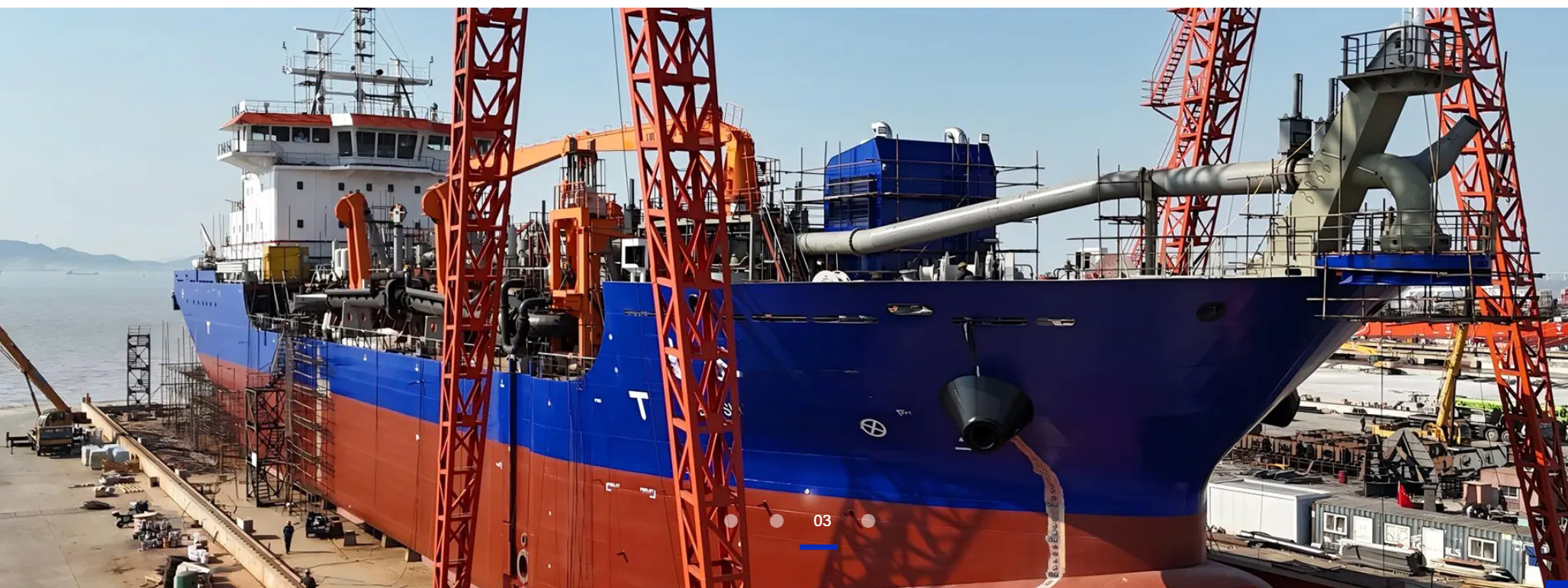
Figure 3: Inside Yanyang Marine’s yard – where technical parameters become high-quality dredgers.
Have Questions or Need More Details?
Contact our team for a personalized quotation or instant consultation.
Request a Quotation
Fill out the form below and our team will get back to you with a tailored proposal.
WhatsApp Direct Chat
Prefer to chat in real-time? Message us on WhatsApp for instant assistance & quick answers.
- Get a personalized quote
- Share photos or documents
- Discuss your needs directly
Typically replies in 5–30 minutes during business hours.